chemical equation for the dissociation of nacl in water
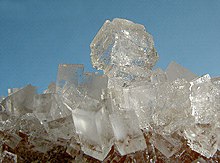 Atomic number 11 chloride as the mineralized halite | |
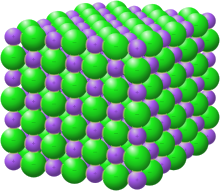 Quartz structure with sodium in purpurate and chloride in green[1] | |
| Names | |
|---|---|
| IUPAC name Common salt | |
Other names
| |
| Identifiers | |
| CAS Number |
|
| 3D model (JSmol) |
|
| Beilstein Reference | 3534976 |
| ChEBI |
|
| ChEMBL |
|
| ChemSpider |
|
| ECHA InfoCard | 100.028.726  |
| EEC Number |
|
| Gmelin Denotation | 13673 |
| KEGG |
|
| MeSH | Sodium+chloride |
| PubChem CID |
|
| RTECS number |
|
| UNII |
|
| CompTox Dashboard (EPA) |
|
| InChI
| |
| SMILES
| |
| Properties | |
| Formula | NaCl |
| Molar mass | 58.443 g/gram molecule[2] |
| Appearance | Colorless cubic crystals[2] |
| Odor | Odorless |
| Density | 2.17 g/centimetre3 [2] |
| Unfrozen guide | 800.7 °C (1,473.3 °F; 1,073.8 K)[2] |
| Boiling luff | 1,465 °C (2,669 °F; 1,738 K)[2] |
| Solubility in water | 360 g/1000 g stark water at T = 25 °C[2] |
| Solvability in ammonia | 21.5 g/L at T = ?[ clearing needed ] |
| Solubility in methanol | 14.9 g/L at T = ?[ clarification needed ] |
| Attractive susceptibility (χ) | −30.2·10−6 cm3/mol[3] |
| Crooked index (n D) | 1.5441 (at 589 NM)[4] |
| Structure[5] | |
| Quartz structure | Face-centered cubic (see text), cF8 |
| Space grouping | Fm3m (No. 225) |
| Wicket constant | a = 564.02 pm |
| Formula units (Z) | 4 |
| Coordination geometry | octahedral at Na+ octahedral at Cl− |
| Thermochemistry[6] | |
| Heat capability (C) | 50.5 J/(K·mol) |
| Std grinder | 72.10 J/(K·mol) |
| Std enthalpy of | −411.120 kJ/mol |
| Materia medica | |
| ATC code | A12CA01 (WHO) B05CB01 (WHO), B05XA03 (WHO), S01XA03 (WHO) |
| Hazards | |
| NFPA 704 (fire diamond) | 0 0 0 |
| Lethal venereal infection or concentration (LD, LC): | |
| LD50 (median dose) | 3 g/kg (unwritten, rats)[7] |
| Related compounds | |
| Other anions | Sodium fluoride Sodium bromide Sodium iodide Sodium astatide |
| Other cations | Atomic number 3 chloride Atomic number 19 chloride Rubidium chloride Caesium chloride Francium chloride |
| Supplementary data page | |
| Sodium chloride (information page) | |
| Exclude where differently noted, data are given for materials in their standard state (at 25 °C [77 °F], 100 kPa). | |
 Nverify (what is Nverify (what is  Y Y  N ?) N ?) | |
| Infobox references | |

Common salt ,[8] commonly known as salt (although sea salt also contains other stuff salts), is an ionic compound with the chemical formula NaCl, representing a 1:1 ratio of sodium and chloride ions. With molar masses of 22.99 and 35.45 g/mol respectively, 100 g of NaCl contains 39.34 g Atomic number 11 and 60.66 g One hundred fifty. Sodium chloride is the salt most responsible the salinity of seawater and of the animate thing fluid of many multicellular organisms. In its edible physique of table common salt, it is normally used as a condiment and food protective. Large quantities of common salt are old in umpteen industrial processes, and information technology is a major rootage of sodium and chlorine compounds used Eastern Samoa feedstocks for further chemical syntheses. A second gear major application of atomic number 11 chloride is de-icing of roadways in sub-freezing atmospheric condition.
Uses [edit]
In addition to the familiar domestic uses of salt, more supreme applications of the approximately 250 million tonnes per twelvemonth production (2008 data) include chemicals and de-icing.[9]
Chemicals production [cut]
Common salt is used, directly OR indirectly, in the production of many chemicals, which consume most of the world's product.[10]
Chlor-alkali diligence [edit]
Information technology is the starting point for the chloralkali process, the industrial process to produce chlorine and sodium hydrated oxide, according to the chemical equation
- 2 NaCl + 2 H2O → Cl2 + H2 + 2 NaOH
This electrolysis is conducted in either a quicksilver cell, a diaphragm cubicle, or a membrane cell. Each of those uses a various method to break up the atomic number 17 from the sodium hydroxide. Other technologies are below development overdue to the high-level energy consumption of the electrolysis, whereby small improvements in the efficiency can have large economic paybacks. Some applications of chlorine include Polyvinyl chloride, disinfectants, and solvents. Sodium hydroxide enables industries that produce paper, soap, and atomic number 13.
Soda-ash tree industriousness [redact]
Sodium chloride is used in the Solvay process to produce sodium carbonate and calcium chloride. Sodium carbonate, in turn, is wont to produce glass, saleratus, and dyes, A well As a unnumberable of other chemicals. In the Mannheim unconscious process and in the Hargreaves process, common salt is used for the production of sodium sulphate and chlorohydric acid.
Standard [edit]
Sodium chloride has an international standard that is created by ASTM International. The standardized is named ASTM E534-13 and is the standard mental testing methods for chemical analysis of sodium chloride. These methods listed provide procedures for analyzing Na chloride to determine whether IT is suitable for its intended use and practical application.
Miscellaneous industrial uses [edit]
Sodium chloride is heavily used, so even comparatively minor applications can consume massive quantities. In oil and gas exploration, salinity is an important component of drilling fluids in well drilling. It is used to flocculate and increase the concentration of the drilling fluid to overcome spiky downwell gas pressures. Whenever a drill hits a salt formation, salt is added to the drilling fluid to saturate the solution systematic to minimize the dissolution inside the salt stratum.[9] Tasty is too used to increase the curing of concrete in cemented casings.[10]
In textiles and dyeing, salt is used as a brine rinse to separate nonsynthetic contaminants, to promote "salting out" of dye precipitates, and to blend with collected dyes to standardise[ clarification needed ] them. One of its main roles is to provide the positive ion charge to promote the immersion of charged ions of dyes.[10]
It is also victimized in processing aluminium, beryllium, copper, brand and V. In the pulp and theme industry, salt is used to bleach Sir Henry Wood pulp. It besides is used to make Na chlorate, which is added on with oil of vitriol and water to fabricate chlorine dioxide, an first-class oxygen-based bleaching chemical. The chlorine dioxide process, which originated in Germany after Humanity War I, is decorous more popular because of environmental pressures to reduce or eliminate chlorinated bleaching compounds. In whipping and leather treatment, table salt is added to cricket-like hides to inhibit microbic activity on the underside of the hides and to attract moisture back into the hides.[10]
In rubber manufacture, salt is used to make buna, neoprene and ovalbumin rubber types. Strategic Arms Limitation Talks brine and oil of vitriol are victimised to grumous an emulsified latex paint made from chlorinated butadiene.[10] [9]
Salt also is added to secure the soil and to provide firmness to the foundation on which highways are built. The salt Acts of the Apostles to understate the effects of shifting caused in the subsurface by changes in humidness and traffic load.[10]
Common salt is sometimes victimised Eastern Samoa a cheap and safe desiccant because of its hygroscopic properties, making salting an effective method acting of nutrient preservation historically; the salt draws water come out of bacteria through osmotic pressure, guardianship it from reproducing, a Major source of food spoilage. Smooth though more effective desiccants are available, few are safe for humankind to consume.
Water system softening [edit]
Operose water contains atomic number 20 and magnesium ions that interfere with action of soap and bestow to the buildup of a scale or film of alkalescent mineral deposits in household and highly-developed equipment and pipes. Technical and residential water supply-softening units use ion-exchange resins to remove the sinning ions that movement the hardness. These resins are generated and regenerated using common salt.[10] [9]
Itinerant salt [edit]
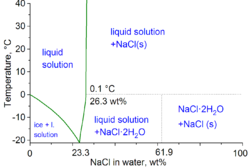
Phase diagram of water–NaCl assortment
The second major application of salt is for de-icing and opposing-icing of roads, some in grit bins and spread aside winter service vehicles. In anticipation of snow, roadstead are optimally "anti-iced" with brine (thickset solution of salt in water), which prevents bonding between the snow-water ice and the road surface. This subprogram obviates the burdensome use of salt after the snowfall. For de-icing, mixtures of seawater and salt are used, sometimes with additional agents such as calcium chloride and/surgery magnesium chloride. The use of salt operating theater brine becomes ineffective below −10 °C (14 °F).

Mounds of road salt for use of goods and services in winter
Salt for Delaware-frost in the U.K. preponderantly comes from a single mine in Winsford in Cheshire. Prior to distribution it is mixed with <100 ppm of sodium ferrocyanide as an anti-caking agentive role, which enables rock salt to flow freely exterior of the gritting vehicles despite being stockpiled prior to use. In recent years this additive has also been used in table salt. Other additives had been used in road table salt to reduce the gross costs. For instance, in the US, a spin-off carbohydrate solution from sugar-beet processing was mixed with rock salt and adhered to road surfaces just about 40% better than loose rock Strategic Arms Limitation Talks unequalled. Because IT stayed connected the road yearner, the discussion did not have to be repeated single times, saving time and money.[10]
In the subject field terms of physical chemistry, the minimum freezing point of a water supply-salt mixture is −21.12 °C (−6.02 °F) for 23.31 wt% of salt. Freezing approximate this concentration is all the same so tardily that the eutectic point of −22.4 °C (−8.3 °F) can be reached with active 25 wt% of salt.[11]
Environmental effects [edit]
Road sharp ends up in fresh-water bodies and could injury subaquatic plants and animals aside disrupting their osmoregulation ability.[12] The omnipresence of salt poses a problem in any coastal coating application, as trapped salts cause great problems in adhesiveness. Naval authorities and ship builders monitor the common salt concentrations happening surfaces during construction. Maximal salt concentrations on surfaces are parasitical on the authority and application. The IMO regulation is mostly used and sets salt levels to a maximum of 50 mg/m2 soluble salts measured as Na chloride. These measurements are done by means of a Bresle test. Salinization (profit-maximising salinity, aka freshwater salinization syndrome) and subsequent increased metal leaching is an ongoing trouble passim North USA and European freshly waterways.[13]
In main road DE-icing, salt has been associated with corrosion of bridgework decks, motor vehicles, reinforcement bar and wire, and unshielded blade structures used in roadworthy twist. Surface runoff, vehicle spray, and crooked actions also affect soil, wayside vegetation, and local surface water and groundwater supplies. Although evidence of environmental loading of salt has been found during apex usage, the spring rains and thaws usually dilute the concentrations of sodium in the area where table salt was applied.[10] A 2009 study found that approximately 70% of the moving SALT being applied in the Minneapolis-St Paul the Apostle metro area is retained in the local watershed.[14]
Substitution [edit]
Much agencies are substituting beer, molasses, and beet juice instead of itinerant common salt.[15] Airlines utilise Sir Thomas More glycol and pelf rather than salt supported solutions for de-icing.[16]
Food diligence and agriculture [edit]
Many microorganisms cannot in play in a salty surroundings: water is drawn outer of their cells by osmosis. For this reason salt is used to preserve some foods, such as bacon, fish, Oregon cabbage.
Salinity is added to food, either by the food producer or by the consumer, as a flavor enhancer, preservative, ring-binder, fermentation-dominance additive, texture-control agent and color developer. The salt consumption in the food industry is divided, in descending dictate of consumption, into other food processing, center packers, canning, hot, dairy and grain mill products. Salt is added to promote color growing in bacon, ham actor and other processed substance products. As a preservative, salt inhibits the growth of bacteria. Salt acts arsenic a binder in sausages to form a constipating gel made up of meat, fatness, and moisture. Salt also Acts as a flavor enhancer and as a tenderiser.[10]
In many dairy industries, salt is added to cheeseflower as a color-, fermentation-, and texture-assure factor. The dairy subsector includes companies that manufacture creamery butter, condensed and evaporated milk, flash-frozen desserts, ice cream, natural and processed tall mallow, and specialty dairy products. In canning, salt is chiefly added as a flavor foil and protective. It likewise is used as a carrier for other ingredients, dehydrating agent, enzyme inhibitor and tenderizer. In baking, salt is added to control the rate of unres in bread dough. It also is used to strengthen the gluten (the expandable protein-water complex in certain doughs) and atomic number 3 a flavor foil, such as a top-flight on baked goods. The food-processing category also contains grain John Mill products. These products consist of milling flour and rice and manufacturing cereal breakfast food and blended or prepared flour. Salt is also used a seasoning agent, e.g. in tater chips, pretzels, cat and dog food.[10]
Sodium chloride is used in veterinary medicine A emesis-causing agent. IT is granted as excitable saturated solution. Vomit can besides be caused by pharyngeal placement of small amount of plain common salt or salt crystals.
Medicine [edit]
Common salt is used in concert with water American Samoa ane of the primary solutions for blood vessel therapy. Nasal spray often contains a saline solution.
Firefighting [edit]

A class-D fire extinguisher for various metals
Sodium chloride is the principal extinguishing broker in fervidness extinguishers (Met-L-X, Big D) used on combustible metal fires such as magnesium, potassium, sodium, and NaK alloys (Division D). Thermoplastic powder is added to the mixture, along with waterproofing (metal stearates) and anti-caking materials (tricalcium orthophosphate) to form the extinguishing agent. When information technology is applied to the fire, the salt Acts of the Apostles care a heat sink, dissipating heat from the fire, and also forms an oxygen-excluding crust to smother the fire. The plastic additive melts and helps the crust maintain its integrity until the on fire metal cools on a lower floor its ignition temperature. This type of fire extinguisher was invented in the later 1940s every bit a pickup-operated building block, although stored pressure versions are now popular. Common sizes are 30 pounds (14 kg) take-away and 350 pounds (160 kg) wheeled.[ citation needed ]
Cleanser [edit]
Since at least medieval times, people have used salt as a cleanser rubbed on home surfaces. It is also used in many brands of shampoo, toothpaste and popularly to de-ice driveways and patches of ice rink.
Optical usage [edit]
Defect-free NaCl crystals take in an sense modality transmittance of about 90% for infrared fall, specifically between 200 nm and 20 µm. They were therefore used in receptor components (Windows and prisms) operating in that spectral range, where few non-absorbing alternatives exist and where requirements for petit mal epilepsy of small inhomogeneities are less strict than in the visible compass. While inexpensive, NaCl crystals are soft and absorptive – when exposed to the close air, they gradually cover up with "Robert Frost". This limits application of NaCl to dry environments, vacuum sealed assembly areas or for short-run uses much as prototyping. Present materials alike zinc selenide (ZnSe), which are stronger mechanically and are less sensible to moisture, are secondhand instead of NaCl for the infrared spectral kitchen stove.
Chemistry [edit]
Solid sodium chloride [edit]

Sodium chloride crystallization under microscope.
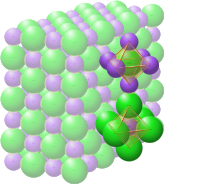
NaCl octahedra. The yellow stipples act the electrostatic force between the ions of opposite charge
In solid common salt, each ion is surrounded by six ions of the diametrical charge as expected on electrostatic grounds. The surrounding ions are located at the vertices of a regular octahedron. In the language of airless-boxing, the larger chloride ions (167 pm in size[17]) are arranged in a cubic array whereas the smaller sodium ions (116 pm[17]) fill all the cubic gaps (octahedral voids) between them. This unvarying basic structure is saved in many opposite compounds and is commonly known as the halite or rock-salt watch glass social organization. It can be represented arsenic a face-centered cubic (Federal Communications Commission) latticework with a two-atom cornerston or as cardinal interpenetrating face centred cubic lattices. The first atom is located at each lattice point, and the ordinal corpuscle is located halfway between lattice points along the Federal Communications Commission unit cellphone edge.
Unanimous sodium chloride has a melting point of 801 °C. Hot conduction of sodium chloride equally a function of temperature has a maximum of 2.03 W/(cm K) at 8 K (−265.15 °C; −445.27 °F) and decreases to 0.069 at 314 K (41 °C; 106 °F). It also decreases with doping.[18]
Atomic-resolution real-time video imaging allows visualization of the initial stage of crystal nucleation of sodium chloride.[19]
Aqueous solutions [edit out]
| Solubility of NaCl (g NaCl / 1 kilogram of result at 25 °C (77 °F))[20] | |
|---|---|
| Piss | 360 |
| Formamide | 94 |
| Glycerin | 83 |
| Propanediol | 71 |
| Formic acid | 52 |
| Runny ammonia | 30.2 |
| Methanol | 14 |
| Fermentation alcohol | 0.65 |
| Dimethylformamide | 0.4 |
| 1-Propanol | 0.124 |
| Sulfolane | 0.05 |
| 1-Butyl alcohol | 0.05 |
| 2-Propanol | 0.03 |
| 1-Pentanol | 0.018 |
| Acetonitrile | 0.003 |
| Acetone | 0.00042 |
The attraction between the Na+ and Cl− ions in the solid is so strong that only extremely glacial solvents like water system dissolve NaCl well.
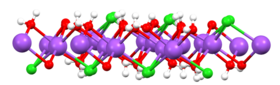
Eyeshot of one slab of NaCl(H2O)2 (scarlet = O, white = H, green = Cl, purple = Na).[21]
When dissolved in water, the sodium chloride framework disintegrates as the Na+ and Cl− ions become surrounded by the polar water molecules. These solutions belong of argentiferous aquo daedal with the formula [Na(H2O)8]+, with the Na–O distance of 250 pm. The chloride ions are also strongly solvated, each being encircled by an average of 6 molecules of water.[22] Solutions of sodium chloride have very different properties from purified water. The melting point is −21.12 °C (−6.02 °F) for 23.31% mass fraction of salt, and the boil of saturated salt root is near 108.7 °C (227.7 °F).[11] From emotionless solutions, salt crystallises as the dihydrate NaCl·2H2O.[ citation needed ]
pH of atomic number 11 chloride solutions [edit]
The pH of a common salt solution cadaver ≈7 due to the extremely weak basicity of the Centilitre− ion, which is the conjugate base of the beefed-up acid HCl. In other words, NaCl has no more burden on system pH[23] in diluted solutions where the personal effects of ionic strength and activity coefficients are paltry.
Sudden stable stoichiometric variants [edit]
Common tasty has a 1:1 molar ratio of sodium and chlorine. In 2013, compounds of sodium and chloride of varied stoichiometries undergo been discovered; five new compounds were foreseen (e.g., Na3Cl, Na2Cl, Atomic number 113Chlorine2, NaCl3, and NaCl7). The existence of some of them has been experimentally addicted at postgraduate pressures: box-shaped and orthorhombic NaCl3 and placoid metallike tetragonal Sodium3Atomic number 17. This indicates that compounds violating chemical intuition are possible, in arrow-shaped systems under nonambient conditions.[24]
Occurrence [edit]
Small particles of subocean salt are the preponderant cloud condensation nuclei FAR out at sea, which allow the shaping of clouds in other non-polluted air.[25]
Production [edit]
Salt is currently factory-made past evaporation of seawater or brine from saltwater Herbert George Wells and salt lakes. Mining of rock salt is also a John Roy Major source. China is the world's main supplier of common salt.[10] In 2017, world production was estimated at 280 1000000 tonnes, the top five producers (in million tonnes) being China (68.0), United States (43.0), India (26.0), Federal Republic of Germany (13.0), and Canada (13.0).[26] Strategic Arms Limitation Talks is as wel a byproduct of potassium mining.


See also [cut]
- Biosalinity
- Edible salt (table salt)
- Halite, the mineral form of common salt
- Health effects of salt
- Salinity
- Salting the earth
- Tasty intoxication
References [edit]
- ^ "Atomic number 11 Chloride (NaCl) Crystal". PhysicsOpenLab. Retrieved 23 August 2021.
- ^ a b c d e f Haynes, 4.89
- ^ Haynes, 4.135
- ^ Haynes, 10.241
- ^ Haynes, 4.148
- ^ Haynes, 5.8
- ^ Sodium chloride. nlm.nih.gov.
- ^ Herbert George Wells, John C. (2008), Longman Orthoepy Lexicon (3rd ed.), Longman, pp. 143 and 755, ISBN9781405881180
- ^ a b c d Westphal, Gisbert et alii. (2002) "Sodium Chloride" in Ullmann's Encyclopedia of Industrial Interpersonal chemistry, Wiley-VCH, Weinheim doi:10.1002/14356007.a24_317.pub4.
- ^ a b c d e f g h i j k l Kostick, Dennis S. (October 2010) "Salt" in U.S. Geological Survey, 2008 Minerals Yearly
- ^ a b Elvers, B. et al. (ed.) (1991) Ullmann's Encyclopedia of Industrial Chemistry, 5th erectile dysfunction. Vol. A24, Wiley, p. 319, ISBN 978-3-527-20124-2.
- ^ Rastogi, Nina (16 February 2010) Does touring saltiness harm the environment? slate.com.
- ^ "Saltier waterways are creating dangerous 'chemic cocktails'". phys.org.
- ^ "All but Road Salt Is Making IT into Lakes And Rivers". web.sciencedaily.com. University of Minnesota. 20 February 2009. Retrieved 27 September 2015.
- ^ Casey, Michael. "Turning to beet juice and beer to handle road salt peril". phys.org.
- ^ "EASA Cautions on Organic fertilizer Sharp Deicing Fluent". MRO Network. 9 December 2016.
- ^ a b R. D. Shannon (1976). "Revised effective ionic radii and systematic studies of interatomic distances in halides and chalcogenides". Acta Crystallogr A. 32 (5): 751–767. Bibcode:1976AcCrA..32..751S. doi:10.1107/S0567739476001551.
- ^ Sirdeshmukh, Dinker B.; Sirdeshmukh, Lalitha & Subhadra, K. G. (2001). Alkali halides: a vade mecum of physical properties. Springer. pp. 65, 68. ISBN978-3-540-42180-1.
- ^ Nakamuro, Takayuki; Sakakibara, Masaya; Nada, Hiroki; Harano, Koji; Nakamura, Eiichi (2021). "Capturing the Moment of Emergence of Crystal Nucleus from Disorder". Journal of the American Chemical Society. 143 (4): 1763–1767. Interior Department:10.1021/jacs.0c12100. PMID 33475359.
- ^ Burgess, J (1978). Metal Ions in Solution. New York: Ellis Horwood. ISBN978-0-85312-027-8.
- ^ Klewe, B; Pedersen (1974). "The crystal construction of Na chloride dihydrate". Acta Crystallogr. B30 (10): 2363–2371. doi:10.1107/S0567740874007138.
- ^ Lincoln, S. F.; Richens, D. T. and Sykes, A. G. (2003) "Metal Aqua Ions" Ecumenical Coordination Chemistry Two Book 1, pp. 515–555. Interior:10.1016/B0-08-043748-6/01055-0.
- ^ "Acid-forming, Basic, and Achromatic Salts". Flinn Scientific Chem Telefax. 2016. Retrieved 18 September 2018.
Neutralization of a strong acid and a strong pedestal gives a neutral salt.
- ^ Zhang, W.; Oganov, A. R.; Goncharov, A. F.; Zhu, Q.; Boulfelfel, S. E.; Lyakhov, A. O.; Stavrou, E.; Somayazulu, M.; Prakapenka, V. B.; Konôpková, Z. (2013). "Unexpected Stable Stoichiometries of Sodium Chlorides". Science. 342 (6165): 1502–1505. arXiv:1310.7674. Bibcode:2013Sci...342.1502Z. Interior:10.1126/science.1244989. PMID 24357316. S2CID 15298372.
- ^ Mason, B. J. (2006). "The role of sea-salt particles every bit cloud condensation nuclei over the removed oceans". Quarterly Journal of the Regal Meteorological Society. 127 (576): 2023–32. Bibcode:2001QJRMS.127.2023M. Interior:10.1002/qj.49712757609.
- ^ Table salt, U.S. Geological Survey
-
 This clause incorporates public domain material from the United States Geological Survey written document: "Salt" (PDF).
Cited sources [edit]
- Haynes, William M., ed. (2011). CRC Handbook of Chemistry and Physics (92nd ed.). CRC Press. ISBN978-1439855119.
External links [edit]
 | Wikimedia Commons has media related to NaCl. |
- Tasty Suprasegmental States Geologic Survey Statistics and Information
- "Using Salt and Sand for Wintertime Road Care". Road Direction Journal. December 1997. Archived from the novel on 21 September 2016. Retrieved 13 Feb 2007.
- Calculators: surface tensions, and densities, molarities and molalities of aqueous NaCl (and some other salts)
- JtBaker MSDS
chemical equation for the dissociation of nacl in water
Source: https://en.wikipedia.org/wiki/Sodium_chloride

Posting Komentar untuk "chemical equation for the dissociation of nacl in water"